RETROTOURS NEWSETTER
I HATE DETOURS!
When on a RetroTour I don’t put my cell phone in a handlebar mounted holder and follow the blue line. That wouldn’t be very ‘retro’ now, would it? Old school ‘GPS’ involves a written set of instructions derailing the desired route with way-points like “at the big oak tree on the right” and instructions like “zig-left then zag-right to cross the river”. The route sheet can be displayed in a handlebar mounted
enduro-style route sheet holder which displays one line at a time and is scrolled ahead, line-by-line, with a little knob on the side of a water proof plastic case. Generally though, for road riding, I use a plastic-faced map holder mounted to the top of a tank bag. This does involve looking down from time to time,but with practice, it becomes routine.
This method puts one in touch with the surroundings more than a satellite guided computer ever could. When there is a doubt, asking a local for clarification adds a personal contact aspect to the trip. Sure, sometimes we get lost, but that’s not always such a bad thing is it? After a little extra unplanned
exploration, we always get where we need to be, and as often as not, such unplanned excursions lead us to a very special spot, all the more special because it was unplanned.
BUT, when there is detour, the whole system can go to pot, which is exactly why I HATE DETOURS.
It seems like whenever I try to follow the orange signs with black arrows telling me how to make the detour, well, I can’t. The signage just peters out or there is no signage. Recently I was trying my best to follow the detour route until, after 6 or 8 unmarked miles, I came to a cross road with detour arrows
pointing in several different directions. I HATE DETOURS!
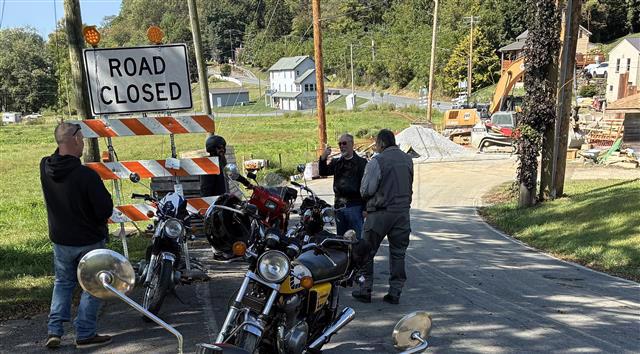
More often than not, when I see a road closed or a detour sign, I will continue on my pre-chosen route regardless. More often than not, if there is no active construction going on—usually the case on weekends—I will ride through the detour if it looks easy to do on a motorcycle. If safe passage looks
questionable, I will stop and explore on foot, seeking a safe way through for the group. If there is a short stretch of gravel, or a maze of construction equipment that can be woven through, we may go through and continue on out merry way. It makes me feel like I got away with something—silly I know, but oh so satisfying. Of course, if the bridge is gone, we have to turn around and try to follow the inevitably poorly marked detour route. I HATE DETOURS!
Wrenching is a big part of one’s vintage motorcycle life’s journey, and one often encounters detours when wrenching. These unplanned obstacles can derail a project just as a detour on the road can derail a route sheet. There is no GPS for wrenching (although there are shop manuals) and the best approach in my experience is to keep moving forward while trying to find a way around or through the ‘detour’.
Instead of focusing on the obstacle, try to look beyond it, and keep moving in the desired direction. Often, there is a lesson that can be learned while moving forward that will make it easier to overcome the obstacle. For example, if there is an issue (a detour if you will) with re-assembling the left fork
assembly, set it down and assemble the right fork assembly. You very well may learn something doing the right fork that will enable you to get around or through the issue with the left fork.
A similar approach works for racing too. When you approach a bike in front of you, even though you may be faster, you can have trouble getting past if you focus on the taillight or rear fender. The presumably slower rider is essentially a detour. Instead, force your concentration to the track beyond the bike in front of you and you may very well find that you can ride around the (moving) obstacle without too much trouble. A lot like riding through an inactive construction zone marked ‘Road Closed Ahead’ or ‘Detour’. I HATE DETOURS!
And yes, life is full of detours. You can get off track and lost trying to avoid these rough spots. Or you can calmly, cautiously, approach them head-on to see if there is a reasonable way through. If not, you can always turn around and try ‘Plan B’.
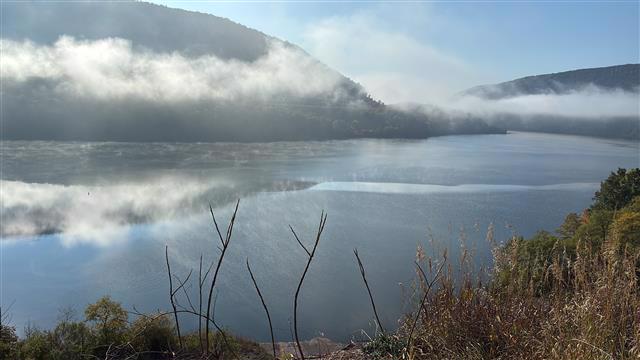
Sometimes we find ourselves in the middle of nowhere.
Sometimes, in the middle of nowhere, we find ourselves.
RIDE A PIECE OF THE PAST ON THE PATH LESS TAKEN!
|